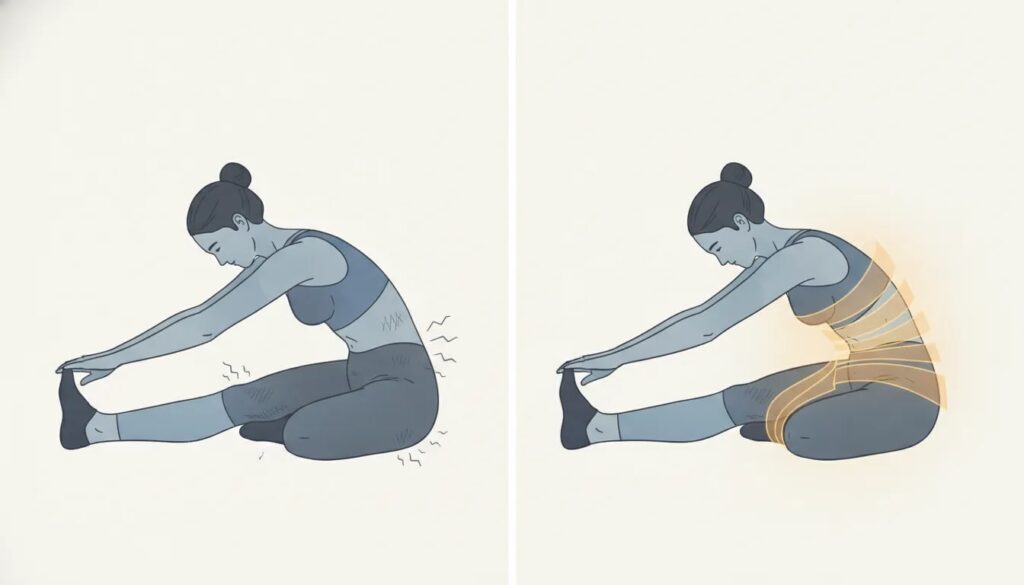

Many people do the exercises, build strength, and still keep waking up with the same back, neck, rib, or hip discomfort. That can feel confusing, especially when the rehab plan looks correct on paper. One missing piece is often Diaphragmatic breathing, because breathing is not just about oxygen. It is also a movement pattern that affects core function, spinal support, and how well your body handles load.
Diaphragmatic breathing matters because every exercise sits on top of the way you breathe. If your breathing pattern is shallow, chest-dominant, reversed, or paired with breath-holding at the wrong time, your body may never get the support it needs. That can make good exercises less effective and can help explain why pain keeps returning.
Table of Contents
- Why Diaphragmatic breathing matters for pain
- The breathing patterns that commonly sabotage recovery
- How to self-assess Diaphragmatic breathing
- A simple 3-step progression to retrain Diaphragmatic breathing
- How to use Diaphragmatic breathing in training and everyday movement
- Common mistakes people make with Diaphragmatic breathing
- When breathing work is most likely to help
- Takeaway: better breathing can make good rehab work actually work
- FAQ
Why Diaphragmatic breathing matters for pain
Diaphragmatic breathing is often described as 360 breathing. The idea is simple. Instead of sending all the air into the upper chest or only into the belly, your rib cage expands and narrows in a more balanced way around the trunk.
That expansion should not be limited to the front of the body. It should also be felt through the sides and into the back. When Diaphragmatic breathing is working well, it helps create better support around the spine and improves the relationship between the rib cage and pelvis.
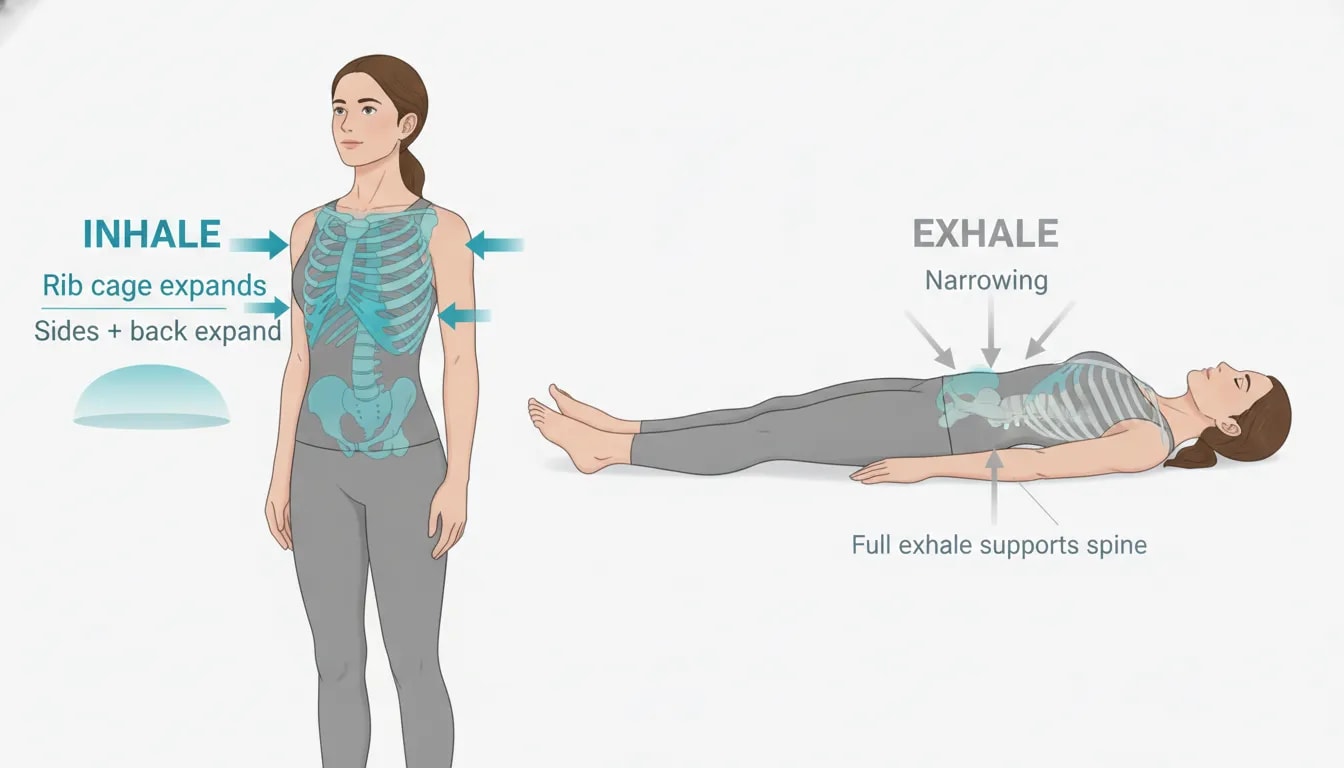
This is one reason breathing has such a strong connection to chronic pain. If the rib cage and pelvis are poorly positioned, the core often struggles to do its job. Then the spine loses some of the support it needs during daily movement, exercise, and sport.
That does not mean breathing is the only cause of pain. It means your breathing pattern may be a hidden factor that keeps interfering with recovery. Even a solid training plan can lose effectiveness if the body is organized poorly every time you inhale, exhale, brace, bend, lift, or rotate.
For people trying to improve movement quality, this is especially important. If you are already working on strength and mechanics, Diaphragmatic breathing can be the piece that helps those changes actually transfer into daily life.
If recurring symptoms show up during running or training, it can help to look at the broader pattern and not just the painful tissue. This is also why recurring issues often need a movement-based lens, similar to what is discussed in this guide on recurring running injury.
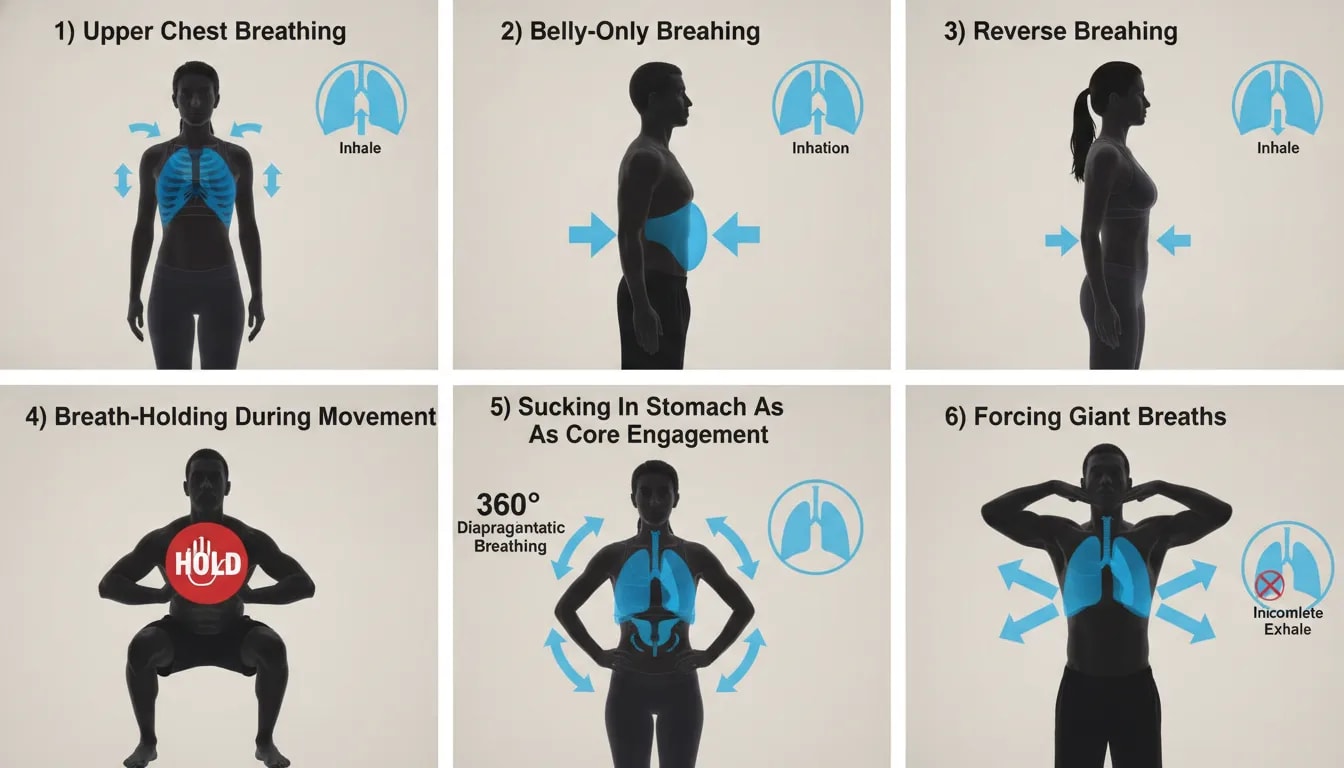
The breathing patterns that commonly sabotage recovery
Not all breathing drills improve pain or movement. Some breathing styles can even create more problems if they become your default pattern during training and daily life.
1. Upper chest breathing
This is common in people who live with stress, long hours sitting, or constant tension. The breath stays high in the chest, the upper body does most of the work, and the lower rib cage does not expand well.
When that happens, the trunk often loses balanced pressure around the spine. The result can be extra stiffness, poor core timing, and a body that never feels truly stable.
2. Belly-only breathing
Many people are told to push the belly out and call that correct breathing. That can be useful as a drill in some contexts, but on its own, it is not the same as Diaphragmatic breathing.
If the breath only moves into the belly and the rib cage does not expand and collapse properly, you are still missing full trunk support. Good breathing is not just front-of-body movement. It is a wider, more complete expansion pattern.
3. Reverse breathing
In reverse breathing, the belly pulls in during inhalation and moves out during exhalation. This can be used intentionally in some training methods, but as a regular movement pattern it tends to work against the kind of support most people need for pain management and efficient movement.
If this becomes automatic during exercise, it can reduce the benefit of the work you are doing. It may also make it harder to organize the rib cage, pelvis, and spine well.
4. Breath-holding during movement
Some people unconsciously hold their breath when they squat, push, reach, get up from a chair, or even walk uphill. That can create unnecessary tension and can disrupt how the core coordinates with movement.
There are moments in heavy lifting where breath management becomes more complex, but for most daily movement and easier exercise progressions, learning to move while breathing well is essential. Diaphragmatic breathing should support movement, not disappear under effort.
How to self-assess Diaphragmatic breathing
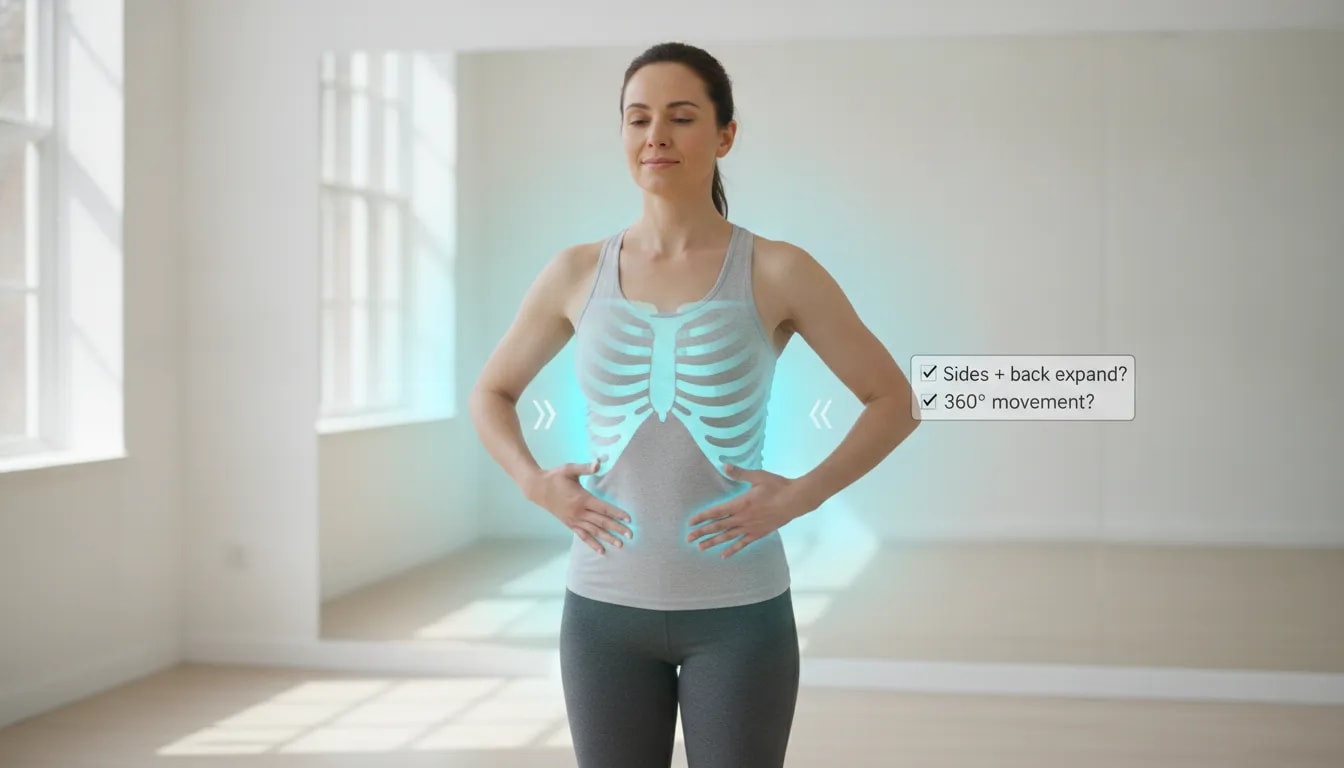
You do not need a lab setup to start checking your breathing pattern. A simple observation can tell you a lot.
Check 1: Watch your rib cage and chest
Stand in front of a mirror. Breathe normally for several breaths. Notice whether the movement goes mostly into the upper chest, mostly into the belly, or whether the rib cage expands and narrows more evenly.
If the shoulders keep lifting or the chest dominates every breath, you may not be using Diaphragmatic breathing effectively.
Check 2: Notice whether the sides and back can expand
Place your hands around the lower rib cage. Inhale gently and see whether you feel outward movement into the front, sides, and back rather than only one region.
The goal is not to force a giant breath. The goal is to feel a more complete expansion around the trunk.
Check 3: Listen to your exhale
A full exhale matters. If you cannot control the exhale, the inhale often becomes disorganized, too. In many breathing retraining drills, a clearly heard controlled exhale is useful because it helps you avoid cutting the breath short.
That matters because Diaphragmatic breathing is not just about inhaling deeply. It is also about exhaling fully enough to organize the trunk for the next breath.
Check 4: See what happens during easy movement
Try a bodyweight squat, push-up against a wall, or a simple reach pattern. Notice whether you immediately hold your breath or lose control of your rib cage and trunk position.
If your breathing pattern falls apart as soon as movement starts, that is a sign the issue is not just at rest. It is a movement pattern problem.
A simple 3-step progression to retrain Diaphragmatic breathing
The best way to improve Diaphragmatic breathing is to progress from awareness, to expansion, to integration. Keep the drills simple and repeatable.
Step 1: Restore length and exhale fully
Stand tall and reach your arms overhead while holding opposite elbows. Think of your body being gently lengthened from head to toe. Keep the chin slightly down rather than lifting it.
From there, focus on a complete exhale. Let the rib cage narrow down instead of forcing the chest up. Then inhale and feel the ribs expand again.
This drill can help you sense the expand-collapse pattern that matters in Diaphragmatic breathing. Use a mirror if needed so you can observe whether the upper chest is taking over.
Step 2: Use a band around the lower rib cage
Wrap a light band around the lower rib cage and cross it in front. As you inhale, the band should move outward. As you exhale, it should narrow inward.
This gives immediate feedback. If the band barely moves, or only the front pushes out, you may need more practice creating a 360 expansion rather than a belly-only pattern.
Step 3: Learn to send the breath into the back
A supported folded position can help. Sit back toward your heels in a kneeling posture (Vajrasana) and place an object such as a soft ball between the thighs and abdomen so the front belly has less room to dominate. Rest your arms and head on support if needed.
Now inhale and exhale with control. Try to feel the breath moving more into the back of the trunk. This can help you understand that Diaphragmatic breathing is not just front expansion. Your back should contribute too.
Once you can feel these patterns, start adding them to easy exercises. Bodyweight movements are the best place to begin. Do not jump straight into hard lifting and expect perfect breathing control.
If five or six good reps suddenly feel more demanding than ten sloppy reps used to feel, that is usually a good sign. Better breathing often makes an exercise more honest because the body has fewer ways to cheat around poor trunk control.
How to use Diaphragmatic breathing in training and everyday movement
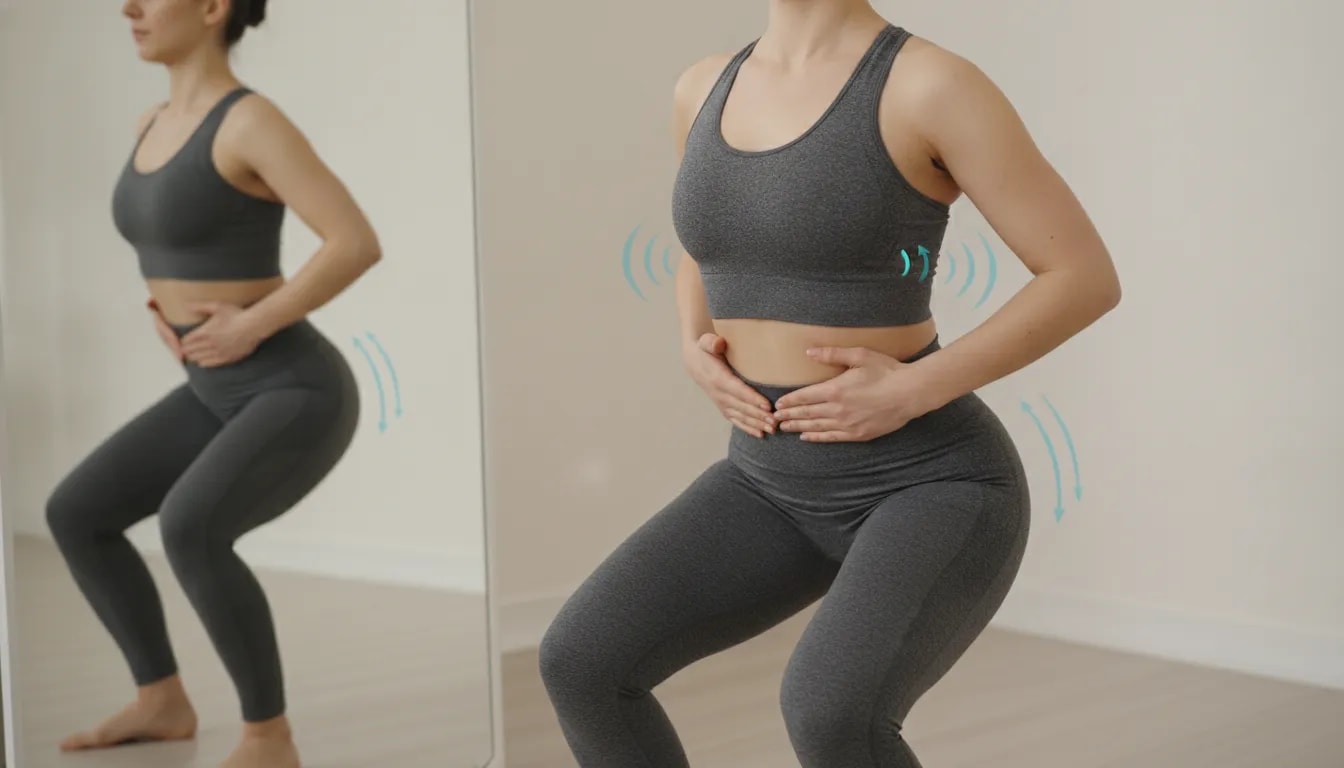
Breathing retraining only helps if it carries over into real life. The goal is not to become good at breathing drills only while standing still.
During exercise
Start with movements that feel easy. Think push-ups against a wall, bodyweight squats, split-stance holds, or simple carries. Keep the rib cage and pelvis organized and let the breath continue through the movement rather than freezing under effort.
As your control improves, Diaphragmatic breathing should begin to show up naturally in your main exercises. That is when the work becomes useful, not just technical.
During sports
Athletes miss this issue all the time. Runners, Hyrox athletes, and cricket players can look strong and conditioned but still lose breathing quality under load.
When fatigue rises, chest breathing and breath-holding often return. That can reduce efficiency and make recurring pain more likely, especially when the body is already compensating elsewhere.
During daily life
Pay attention when lifting grocery bags, climbing stairs, getting off the floor, or working at a desk for hours. If your default pattern is tension, shallow breathing, and rib flare, your body is rehearsing that pattern all day.
Diaphragmatic breathing becomes more effective when it is practiced often in low-stress settings. That repeated exposure helps it become automatic when life and training become more demanding.
If you want more movement-focused education around pain, performance, and body mechanics, the free resources on this movement content page can be useful alongside breathing practice.
Common mistakes people make with Diaphragmatic breathing
The biggest problem is confusion. A lot of people think they are breathing well because they are doing something that looks like a breathing drill.
Thinking belly expansion alone is enough. True Diaphragmatic breathing includes the rib cage, sides, and back, not only the front belly.
Sucking the stomach in and calling it core engagement. That is not the same as creating balanced support around the trunk.
Practicing only at rest. If breathing changes disappear the moment movement begins, the pattern is not yet integrated.
Using advanced loading too early. Learn the pattern in simple positions first.
Forcing giant breaths. Bigger is not always better. Controlled expansion and full exhalation matter more than volume.
Expecting breathing to solve every pain problem by itself. It is an important factor, not the only factor.
If pain keeps returning despite repeated rehab attempts, it may be worth looking at the bigger picture of movement quality, not only isolated exercises. For a more structured approach, this pain-free movement program offers more context on movement coaching and recurring pain patterns.
When breathing work is most likely to help
Diaphragmatic breathing is especially worth assessing if you notice one or more of these patterns:
Pain keeps returning even after strength work
Your neck, upper chest, or shoulders always feel overworked
You struggle to feel your core without tensing everything
You hold your breath during basic movements
You feel unstable or disconnected during exercise
Your trunk stiffness increases the harder you try to brace
These signs do not prove breathing is the whole problem, but they do suggest it deserves attention. A lot of people skip this assessment entirely, which is why they stay stuck.
For broader background on breathing mechanics and the role of the diaphragm, the Cleveland Clinic overview of the diaphragm and the NCBI reference on diaphragm anatomy and function are useful starting points.
Takeaway: better breathing can make good rehab work actually work
Diaphragmatic breathing is not a trendy add-on. It is a core movement skill that influences how your rib cage, pelvis, and spine work together. If your breathing pattern is poor, even well-chosen exercises can lose effectiveness.
The practical goal is simple. Learn to create balanced expansion around the trunk, exhale with control, and keep that pattern while moving. Start with easy positions, use feedback tools if needed, and then integrate Diaphragmatic breathing into simple exercises before pushing intensity.
If you have already tried everything except assessing how you breathe, this may be the missing link. Small changes in breathing can create much bigger changes in stability, movement quality, and pain over time.
FAQ
What is Diaphragmatic breathing?
Diaphragmatic breathing is a breathing pattern where the trunk expands more completely instead of sending the breath only into the upper chest or only into the belly. It is often called 360 breathing because the expansion can be felt in the front, sides, and back of the rib cage and trunk.
Can Diaphragmatic breathing help with back pain?
It can help when poor breathing is contributing to poor spinal support, poor rib cage and pelvis positioning, or weak coordination of the core during movement. It is not a guaranteed cure for every case of back pain, but it can make rehab and strength work more effective.
How do I know if I am not using Diaphragmatic breathing?
Common signs include constant upper chest movement, shoulder lifting with each breath, belly-only breathing, breath-holding during exercise, or difficulty feeling expansion into the sides and back of the rib cage.
Is belly breathing the same as Diaphragmatic breathing?
No. Belly movement can be part of the picture, but Diaphragmatic breathing is broader than that. The rib cage should also expand and collapse well, and the breath should not be limited to the front of the body.
Should I practice Diaphragmatic breathing during workouts?
Yes, but start with easy exercises. First learn the pattern in simple positions. Then bring Diaphragmatic breathing into bodyweight movements before trying to maintain it under heavier or faster training.
Why does breathing affect core engagement?
Breathing influences pressure and expansion around the trunk. When the rib cage and pelvis are better organized and the trunk expands more evenly, the core can support the spine more effectively during movement.