
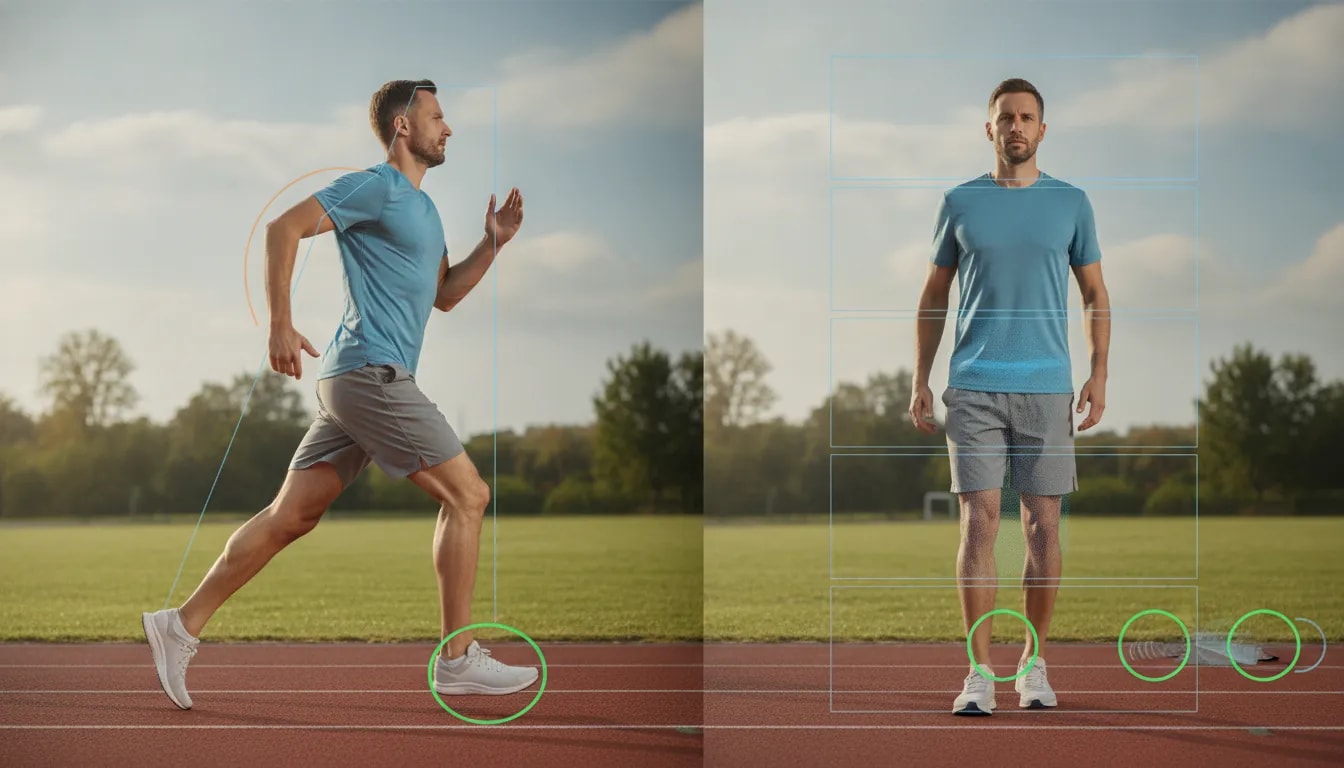
If you have ever felt like your running form looks off, feels inefficient, or seems linked to the same aches coming back again and again, learning how to assess your running form is a useful first step. Many runners try to fix cadence, foot strike, or posture without first seeing what is actually happening. That usually leads to guesswork.
A better approach is simple. First, look at your movement clearly. Then decide what matters. If you want to know how to assess your running form on your own, there are a few high-value things to check that can reveal far more than generic advice about landing on your midfoot or pumping your arms harder.
This guide covers the key areas to review, how to film yourself properly, what common mistakes to avoid, and what your body may be telling you when something looks off.
Table of Contents
- Why learning how to assess your running form matters
- Step 1: Film yourself properly before you assess anything
- Step 2: Check how you stand before you look at how you run
- Step 3: Look at where your foot lands relative to your body
- Step 4: Watch your pelvis when only one foot is on the ground
- Step 5: Check if your arm swing crosses the midline
- Bonus check: listen to your footfalls
- Common mistakes when assessing your own running form
- What to do after you assess your running form
- Takeaway
- FAQ
Why learning how to assess your running form matters
Running form is not just about how your stride looks. It reflects how your body organizes balance, posture, impact, and single-leg control. If those pieces are not working well, the problem often shows up as wasted effort, uneven loading, or recurring pain.
That is why how to assess your running form should start with observation, not correction. Before you try drills or cues, you need to know what your current pattern is doing.
Good self-assessment can help you notice:
Whether you are overstriding
Whether one side moves differently from the other
Whether your standing posture carries into your run
Whether your trunk and pelvis are stable on one leg
Whether your arm swing is showing compensation elsewhere
If recurring discomfort is part of the picture, it can also help to understand why patterns repeat. This article on recurring running injury gives helpful context on how movement habits can keep driving the same issue.
Step 1: Film yourself properly before you assess anything

The first step in how to assess your running form is getting usable footage. If the camera is moving, zooming, or failing to keep your whole body in frame, the assessment will be unreliable.
Use a phone on a tripod or a stable surface. Keep the camera fixed. Record three separate passes so you can see your movement from different angles.
The three views you need
Front view: Run toward the camera
Back view: Run away from the camera
Side view: Run past the camera from the side
Make sure your full body stays visible. Wear clothing that makes it easier to see your outline. Neutral lighting helps too.
This step sounds basic, but it is one of the biggest reasons self-analysis fails. If you cannot see the body clearly and consistently, you cannot assess it well.
A quick filming checklist
Use a fixed camera position
Keep the full body in frame
Record front, back, and side views
Capture several strides, not just one step
Use the same speed you normally run
If you want more structured support for movement analysis and correction, a dedicated running technique improvement program can make the process much more precise.
Step 2: Check how you stand before you look at how you run
One of the most overlooked parts of how to assess your running form is posture when you are not moving. Your standing position often tells you what your body will bring into every stride.
Stand naturally in front of a mirror. Imagine a line running from the top of your head down through your body toward your feet, with gentle lift through the whole frame. Then notice what stands out.
What to look for in standing posture
Is your head pushed forward?
Is one shoulder higher than the other?
Do you sink into one hip more than the other?
Does your body look stacked or collapsed?
Is your weight balanced evenly or clearly shifted?
These are not cosmetic details. They can influence how you absorb force, rotate, and stabilize while running. Many people spend hours sitting at a desk, then try to run with the same shape they have been holding all day.
If your posture is already biased in one direction at rest, there is a good chance that same bias will appear under load and speed.
Step 3: Look at where your foot lands relative to your body
When people ask about running form, they often focus on whether they heel strike, midfoot strike, or land on the forefoot. But a more useful question is where the foot is landing relative to the rest of the body.
This is a key part of how to assess your running form because foot strike type alone does not tell you much. A runner can heel strike without a major issue, and a forefoot striker can still overstride badly.
What to check in the side view
Watch the moment the foot touches down. Is the foot landing far out in front of your body, or is it landing more underneath you?
If it lands too far ahead, you may be overstriding. That can create a braking effect with every step. It also tends to increase the sense that you are reaching forward rather than moving smoothly over the ground.
A useful visual check is the shin at landing. In many efficient strides, the shin is roughly vertical when the foot makes contact. If the lower leg angles strongly forward and the foot is well ahead of the body, that is a sign to pay attention.
Common mistake: obsessing over heel strike
One of the biggest misconceptions in running is that heel striking is automatically bad. It is not that simple. What matters more is whether the foot is landing in a position that supports forward movement rather than acting like a brake.
That is why any serious look at how to assess your running form should focus on foot strike location first.
Step 4: Watch your pelvis when only one foot is on the ground
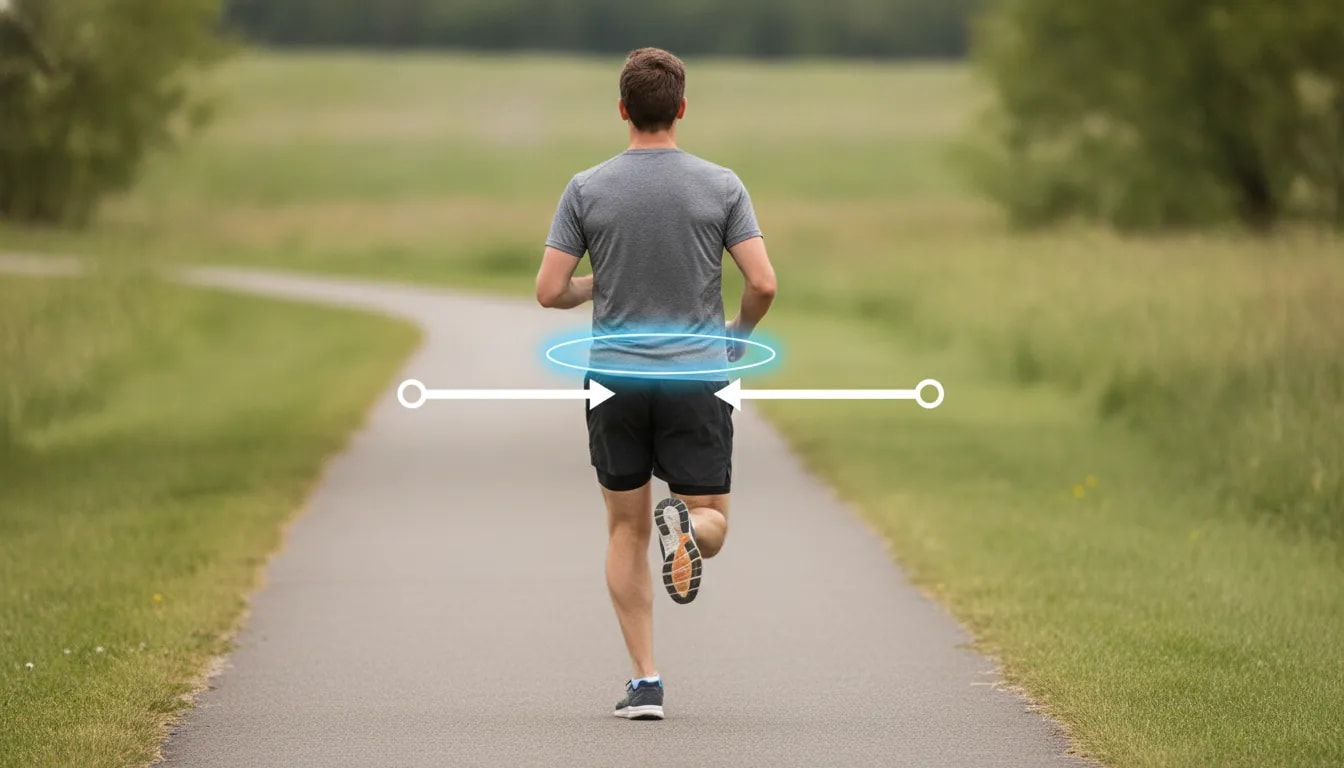
Running is a series of single-leg landings. That means every stride asks your body to control impact and stay organized while one leg accepts your weight. This is one of the most important parts of how to assess your running form, and it is often missed.
Use the back view to watch what happens at the pelvis each time you are standing on one leg during the stride. You are not just checking for a visual flaw. You are looking for a movement pattern.
What to look for from behind
Does one hip drop when the opposite foot leaves the ground?
Does the pelvis sway side to side excessively?
Does one side look less stable than the other?
Does your trunk shift to compensate?
If the pelvis drops or sways a lot, that can suggest limited single-leg control. It may also help explain why issues show up repeatedly on one side of the body.
This does not automatically mean you need to force your hips level or tighten everything up. It means the body may be organizing balance and force in a way that deserves further attention.
If pain is already part of the picture, broader movement coaching may also be relevant. The pain-free movement program is one option for addressing recurring movement-related issues beyond running alone.
Step 5: Check if your arm swing crosses the midline
Arms are often blamed for form problems, but they are not always the main issue. In many cases, the arms are simply showing what the trunk is doing underneath them.
That makes arm swing another useful part of how to assess your running form. In the front view, notice whether your hands stay relatively in line with your body or whether they repeatedly cross inward across the midline.
What crossover arm swing can suggest
If your hands cut across the center of your body, do not assume the fix is just an arm cue. Crossover often reflects how the trunk is rotating or compensating.
In other words, the arms may be the readout, not the root problem. If you only coach the hands without understanding the trunk, the pattern may return quickly.
This is why how to assess your running form works best when you treat the whole body as one connected system rather than isolating one body part at a time.
Bonus check: listen to your footfalls

You do not need video alone to learn something useful. Sound can reveal a lot.
As part of how to assess your running form, listen to your steps while running at a normal pace. Are they very loud, slappy, or uneven from side to side?
What running sound can tell you
Loud impact: May suggest poor impact control
Slappy contact: May indicate a less controlled landing
One side louder than the other: May reveal asymmetry the eye misses
This is especially helpful if you tend to get one-sided discomfort. Sometimes your ears pick up differences that are subtle on video.
For broader education on movement, pain, and performance, there are also useful resources collected here: podcasts and videos.
Common mistakes when assessing your own running form
Self-analysis can be helpful, but only if you avoid a few common traps.
1. Looking for a perfect style
There is no single ideal running form that fits everyone. The goal is not to copy another runner’s style. The goal is to understand your own pattern and spot what may be limiting efficiency or contributing to repeated problems.
2. Focusing on one body part in isolation
If your arm swing looks odd, the issue may be in the trunk. If your foot strike looks heavy, the problem may start higher up. Running form is connected. Isolated fixes often miss the bigger pattern.
3. Changing too many things at once
Once people learn how to assess your running form, they often want to correct everything immediately. That usually creates confusion. Change one variable at a time, then reassess.
4. Filming at the wrong speed or in the wrong context
Assess your normal running, not a forced version of it. If you run differently because you know the camera is there, the footage becomes less useful.
5. Ignoring side-to-side differences
Symmetry matters. Even when a pattern looks acceptable overall, a clear difference between left and right can be important, especially if pain tends to return on the same side.
What to do after you assess your running form

Knowing how to assess your running form is the first step, not the last one. Once you spot a pattern, resist the urge to force a cosmetic fix.
Instead, ask better questions:
Is this pattern consistent across all views?
Is it present on one side more than the other?
Does it match what you feel while running?
Does it relate to any recurring discomfort?
Can you improve it with a simple cue, or does it seem deeper than that?
If the issue is mild, sometimes awareness alone can help. If the pattern is strong, recurring, or linked to pain, a more complete movement assessment may be worthwhile.
Takeaway
If you want to learn how to assess your running form, start by making the assessment reliable. Film yourself well. Look at your standing posture. Check where the foot lands. Watch the pelvis during single-leg support. Notice whether the arm swing crosses the midline. Then listen to the sound of your steps.
That process gives you useful information without getting lost in running myths. Most importantly, it helps you see the difference between a visible symptom and the deeper movement pattern behind it.
When you know what to look for, your next steps become much clearer.
FAQ
What is the first step in how to assess your running form?
The first step is to film yourself properly using a fixed camera. Capture front, back, and side views with your full body in frame. Poor footage makes self-assessment unreliable.
When learning how to assess your running form, should you focus on heel strike?
Not first. It is usually more useful to check where your foot lands relative to your body. A foot landing too far in front can create braking forces regardless of whether you land on the heel, midfoot, or forefoot.
Why should standing posture matter when assessing running form?
Your body often carries its standing habits into movement. Forward head posture, uneven shoulders, or weight shifted into one hip can all show up during running and influence how you load each stride.
How can you tell if your pelvis is not controlling well during running?
From the back view, look for excessive hip drop or side-to-side pelvic sway when only one foot is on the ground. Running is a series of single-leg landings, so this can reveal stability and control issues.
Can sound help with how to assess your running form?
Yes. Loud, slappy, or uneven footfalls can reveal impact issues or left-right asymmetry that may not be obvious on video. Listening is a simple but useful extra layer of assessment.