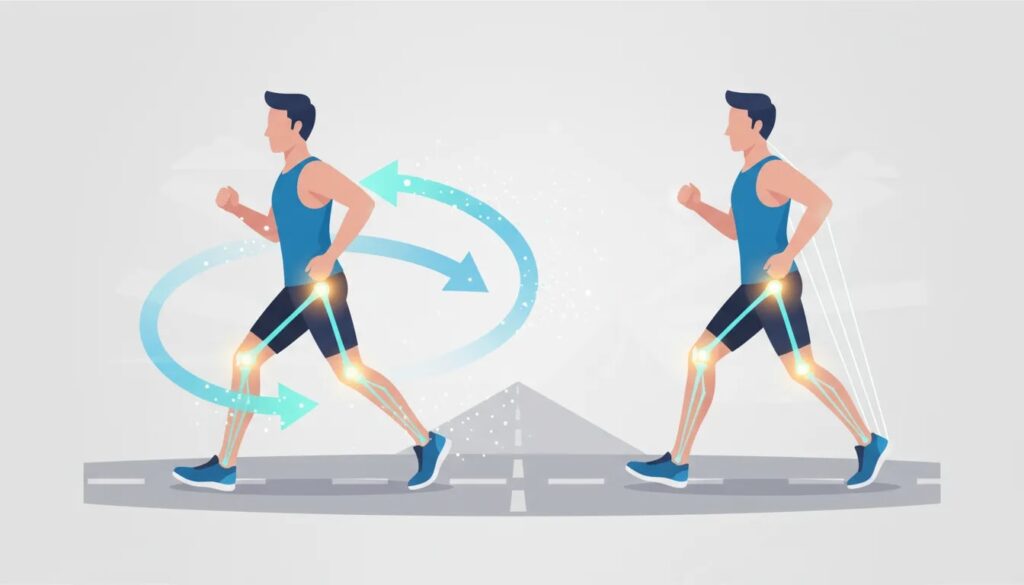
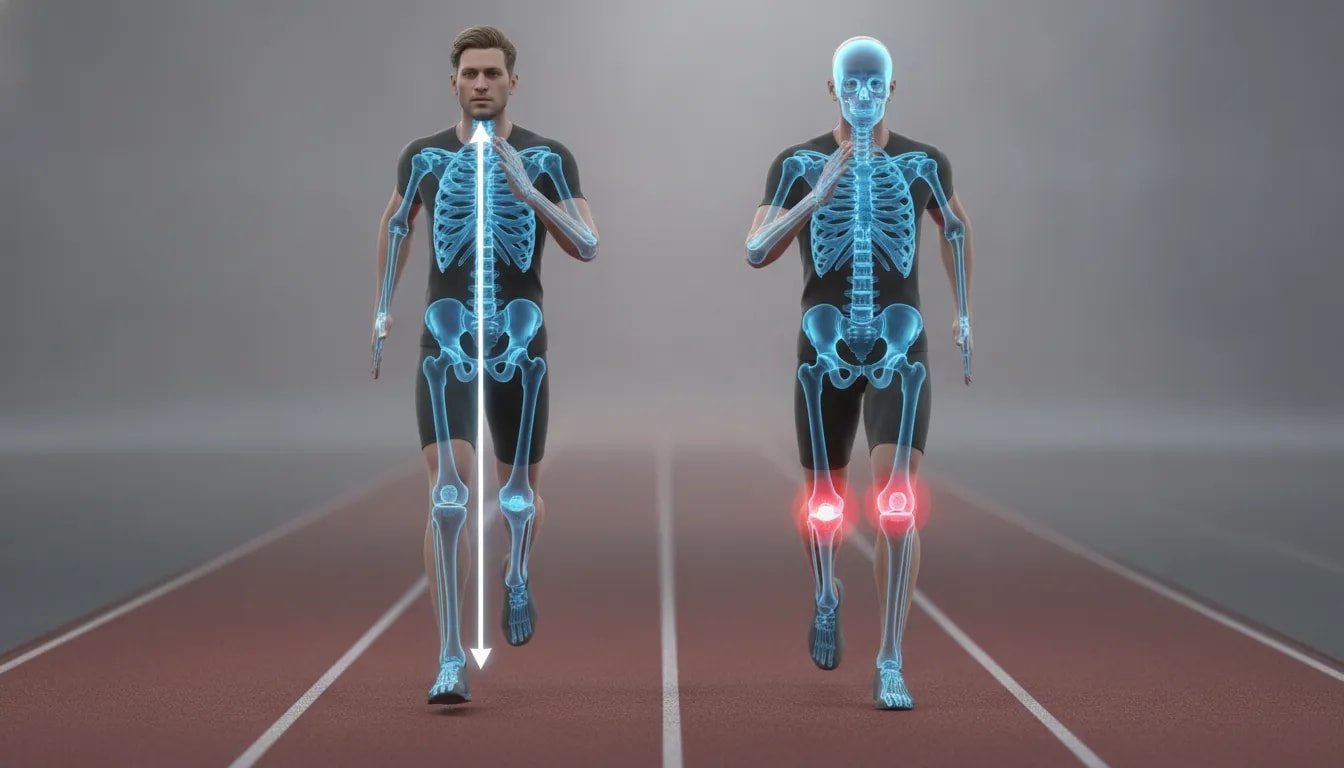
Many runners worry that every run is slowly wearing down their knees. The concern often becomes stronger when knee pain appears during a run, after a long session, or while doing everyday movements such as squatting, lunging, or climbing stairs. So, is running bad for your knees, or is the pain pointing to a different problem?
For most people, running is not automatically harmful to the knees. Knee symptoms are more often connected to how the body controls movement while running, rather than running alone. When movement patterns are inefficient, the knee may repeatedly absorb forces that should be better managed by the hip, ankle, and the rest of the body.
The practical question is not simply whether to run. It is whether your body has the movement control, strength, and coordination to handle the way you currently run.
Table of Contents
- Is Running Bad for Your Knees, or Is It Exposing an Existing Problem?
- Why the Knee Depends on the Hip and Ankle
- Movement Training Is Different From Strength Training
- What to Check If Running Causes Knee Pain
- Common Mistakes When Trying to Protect Your Knees While Running
- Should You Keep Running if Your Knee Hurts?
- The Bottom Line: Running Is Not Automatically the Enemy
Is Running Bad for Your Knees, or Is It Exposing an Existing Problem?
The belief that running inevitably damages knees is common, but it is too simplistic. Running involves repeated loading, and repetition can make an existing control issue more noticeable. That does not mean the act of running itself is necessarily the root cause.
Think of running as a repeated movement test. Every stride asks the body to stabilize, transfer force, and control alignment. If those tasks are handled poorly, the same compensation is repeated many times in one session. The knee often becomes the place where that problem is felt.
In this sense, asking is running bad for your knees may be less useful than asking these questions:
- Can you control your body well during single leg movements?
- Do your hips and ankles contribute effectively when you land and push off?
- Does one knee repeatedly collapse, twist, or feel overloaded?
- Do squats, lunges, or deadlifts also feel uncomfortable or unstable?
- Has your running volume increased faster than your movement capacity?
When pain appears only after running, it is tempting to blame running immediately. But a runner may also have difficulty with other basic patterns that involve knee control. Those patterns can reveal that the issue is broader than a single sport activity.
Running does not remove the need to build movement capacity. It makes that capacity more important because it exposes weak links repeatedly.
Why the Knee Depends on the Hip and Ankle
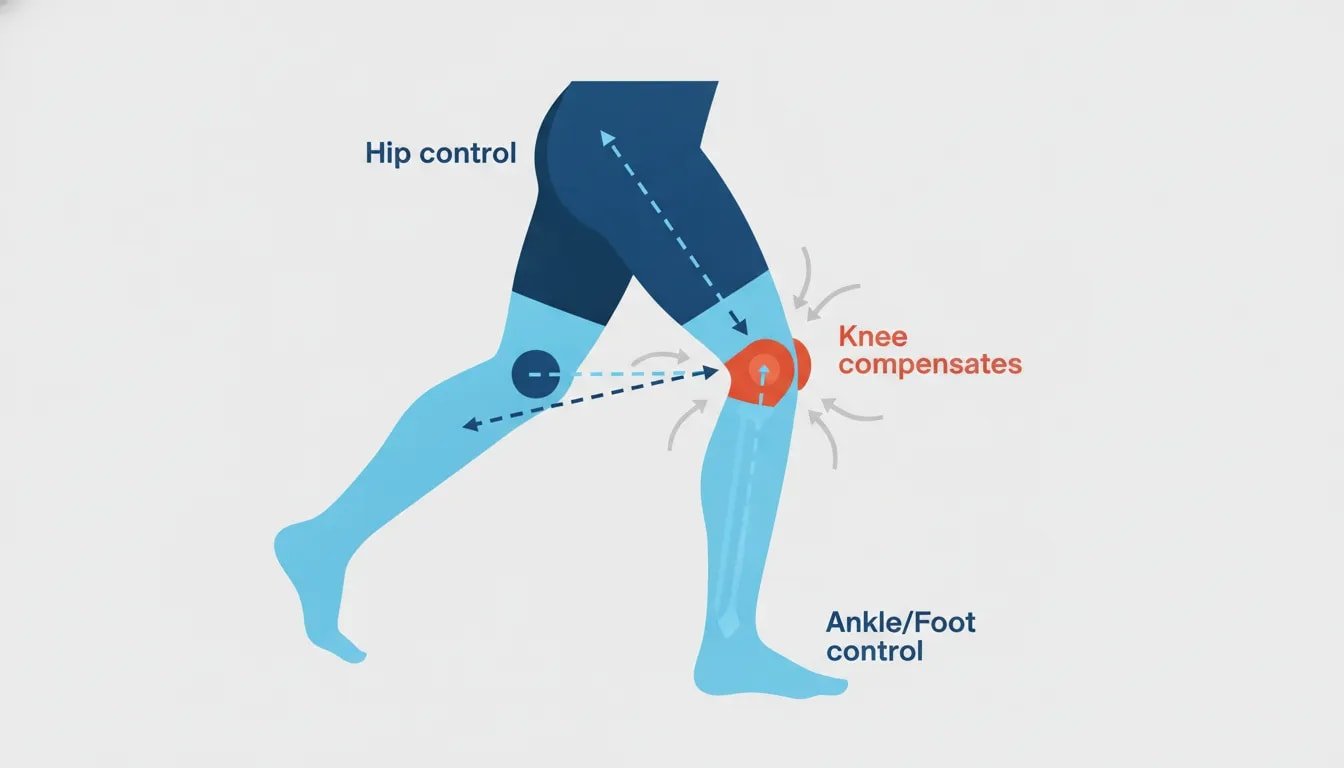
The knee sits between the hip and ankle, so it is strongly influenced by what happens above and below it. Muscles such as the quadriceps, hamstrings, and calf cross the knee and help control it, but knee movement cannot be considered in isolation from the rest of the leg.
The hip helps guide the position of the thigh. The ankle and foot help manage contact with the ground and the movement of the lower leg. When either area lacks control, the knee may have to compensate.
This is why is running bad for your knees is often the wrong starting point for runners with recurring pain. The knee may be where symptoms appear, while the movement issue is being created by poor control at the hip, ankle, or both.
Hip control affects knee position
During running, the hip needs to help control the leg as the body moves over one foot. If the hip does not manage this position well, the thigh may move in a way that changes the load reaching the knee.
This does not mean every knee problem comes from weak hips. It means the hip should be assessed as part of the whole movement pattern. Focusing only on the painful knee can miss the reason it is repeatedly being stressed.
Ankle control affects how force travels upward
The ankle and foot are the body’s first major contact points with the ground during running. If ankle control is limited or poorly coordinated, the lower leg may not move efficiently. The knee then has to adapt to that altered movement.
For this reason, knee discomfort can be linked to a broader chain of movement, from the foot and ankle through the knee to the hip and pelvis. Treating the knee as an isolated hinge often overlooks that chain.
Your center of gravity changes joint demands
Where your body mass sits while moving also matters. When the center of gravity is consistently shifted or poorly controlled, muscles and joints may work differently from their intended roles. This can increase the demand placed on the knees.
A forward, backward, or side to side shift is not automatically harmful. The concern is a repeated movement strategy that leaves the knee managing forces it cannot comfortably control. Over time, that repeated compensation can make symptoms more persistent.
Movement Training Is Different From Strength Training
Strength training is valuable for runners, but strength alone does not guarantee better movement control. A person can become stronger while still relying on the same inefficient squat, lunge, landing, or running pattern.
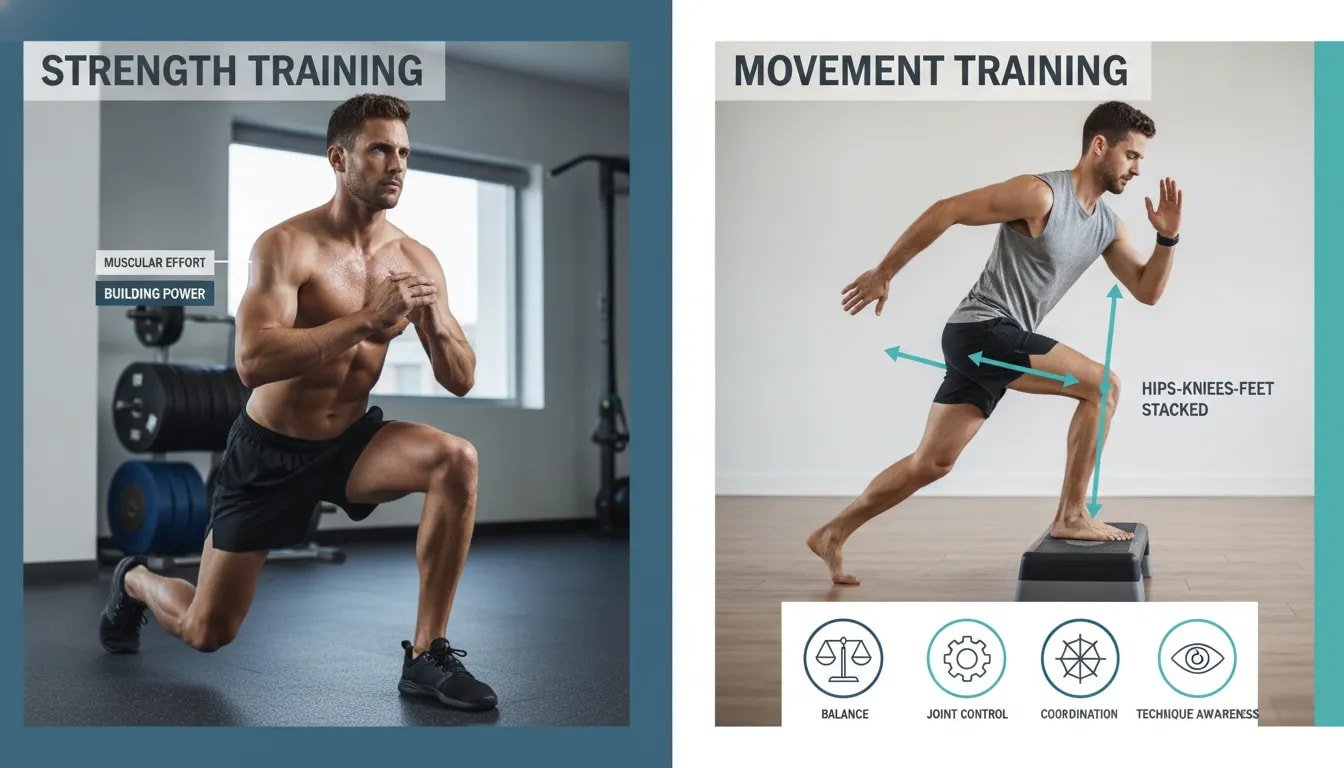
Movement training focuses on how you organize a task. It pays attention to balance, joint control, coordination, body position, and how force is transferred through the body. Strength training can support those qualities, but it does not automatically create them.
This distinction matters for anyone asking is running bad for your knees. If the underlying issue is poor control during repeated movement, adding more running or adding random strength exercises may not fully solve it.
A useful running support plan usually includes both elements:
- Running exposure: Gradually building tolerance for the demands of running.
- Strength work: Developing the physical capacity to produce and absorb force.
- Movement practice: Improving coordination and control in relevant patterns.
- Technique awareness: Noticing how posture, balance, landing, and push off affect the whole leg.
These categories overlap, but they are not identical. A squat may build strength, for example, while also providing an opportunity to assess whether the hips, knees, feet, and trunk are working together effectively.
Before trying to overhaul your stride, it can help to learn how to assess your running form through simple observations rather than guessing based on one painful area.
What to Check If Running Causes Knee Pain
If knee pain happens while running, the most productive response is not always to conclude that running is bad. First, look for repeatable patterns. Does the pain occur at a particular distance, pace, terrain, or fatigue level? Does it show up during other movements too?
Use this checklist to identify what may need attention:
1. Look beyond the knee
Notice what the hip, ankle, and foot are doing when the knee becomes uncomfortable. A knee that appears to move inward, rotate, or feel unstable may be responding to a control issue elsewhere in the leg.
Do not assume that the visible knee motion alone identifies the cause. Movement is a whole body task. The goal is to understand the pattern, not to force the knee into one position without considering the rest of the body.
2. Compare running with basic strength movements
Pay attention to squats, lunges, step downs, and deadlift patterns. If discomfort, weakness, or loss of control also appears in these movements, the running problem may be part of a wider movement issue.
These exercises are not merely gym tasks. They can show whether you can control the same joints and positions that are repeatedly challenged during running.
3. Consider whether training is supporting your running
A runner may run consistently and lift weights regularly but still skip movement-specific practice. If the body continues to use a poor pattern, more training volume can simply reinforce it.
Support work should address the demands that running reveals. That may include controlled single leg work, better hip and ankle coordination, and practice maintaining balance and alignment under load.
4. Watch for recurring patterns instead of chasing one painful session
A single episode of soreness does not always explain a long term problem. The more important clue is recurrence. If pain repeatedly returns in the same knee or at the same stage of running, there may be an unresolved movement strategy behind it.
For a deeper look at why the same issue can keep returning, see this guide on recurring running injuries and persistent movement patterns.
Common Mistakes When Trying to Protect Your Knees While Running
When someone believes running is damaging their knees, the natural reaction is often to stop running completely or focus only on the site of pain. Those choices may be understandable, but they do not always address what is driving the problem.
Blaming every symptom on mileage
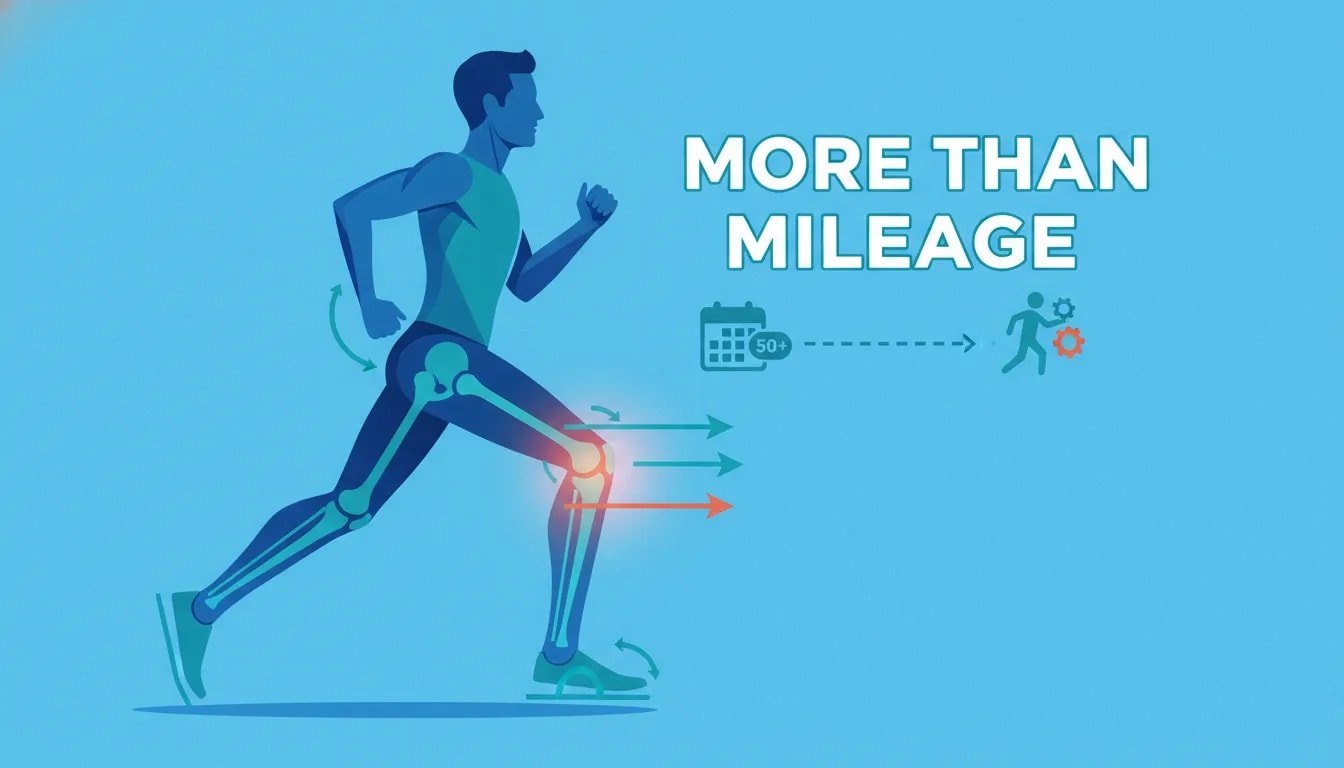
Training volume matters because running is repetitive. However, volume is only one part of the picture. If the movement pattern is poor, even a modest amount of running may trigger symptoms. If movement is controlled and training is well supported, the same activity may be tolerated differently.
Training strength without checking technique
More strength can be useful, but adding load to an uncontrolled pattern may not produce the result you want. The quality of a squat, lunge, hinge, or single leg exercise matters alongside the amount of weight used.
Trying to fix the knee without assessing the chain
The knee is not independent of the hip, ankle, foot, trunk, and overall body position. A plan that only targets the knee may miss the control problem that keeps bringing the load back to the same place.
Changing everything at once
It is easy to respond to pain by changing shoes, stride, mileage, strength training, and mobility work all at once. That makes it harder to understand what is helping. A more useful approach is to identify the likely pattern, make purposeful changes, and observe how your body responds.
General knee-conditioning information can also be found through the American Academy of Orthopaedic Surgeons knee conditioning program. A general program is most helpful when it is adapted to the movements and symptoms that matter to you.
Should You Keep Running if Your Knee Hurts?
There is no universal answer because knee pain can occur for different reasons. The key point is that pain should not be ignored simply because running itself is not automatically harmful. Repeated symptoms are useful information that your current movement capacity, training approach, or both may need attention.
If running repeatedly produces knee pain, consider reducing the aggravating exposure while assessing your movement patterns and building better support around the hips, ankles, and knees. The objective is not to fear running. It is to create a body that can tolerate and control the demands of running more effectively.
Anyone dealing with persistent or recurring symptoms may benefit from individualized movement coaching. A focused chronic pain and movement coaching approach can help examine the patterns that may be maintaining knee, hip, ankle, or back discomfort.
The Bottom Line: Running Is Not Automatically the Enemy
So, is running bad for your knees? Usually, running itself is not the automatic cause of knee damage. It is more useful to view running as a demanding, repetitive activity that can expose poor movement control, inadequate support training, or unresolved compensation patterns.
The knee relies on how well the hip and ankle contribute to movement. When those areas are not controlling their roles effectively, the knee can become the joint that absorbs the consequences. Strength training can help, but movement training and technique awareness are equally important.
If knee pain keeps appearing, do not limit the investigation to the knee or assume you must give up running. Assess the whole movement pattern, build the capacity to control it, and use recurring symptoms as a signal to address the cause rather than only the location of pain.
Frequently Asked Questions
Is running bad for your knees if you have knee pain?
Running is not automatically bad for your knees simply because pain is present. Knee pain may reflect a movement control issue involving the hip, ankle, foot, or overall body position. Repeated pain is a reason to assess the pattern and adjust training rather than assume running alone is the cause.
Why do my knees hurt when I run but not when I walk?
Running repeats a higher-demand movement pattern many times in a session. A control issue that is not noticeable while walking may become more obvious when the body must manage the greater speed, force, balance, and repetition involved in running.
Can weak hips cause knee pain while running?
Hip control can influence how the thigh and knee move during running. If the hip is not contributing effectively, the knee may compensate. However, knee symptoms should be assessed as part of the entire movement chain, including the ankle and foot.
Is strength training enough to prevent running knee pain?
Strength training is supportive, but it is not always enough by itself. A runner can be strong and still use inefficient movement patterns. Combining strength work with movement practice, running technique awareness, and appropriate running exposure is more complete.
Should I only train my knee if it hurts during running?
No. The knee is influenced by the hip and ankle, so a knee-only approach may overlook the source of repeated overload. Assessing how the whole leg and body move is usually more useful than treating the knee as an isolated problem.