
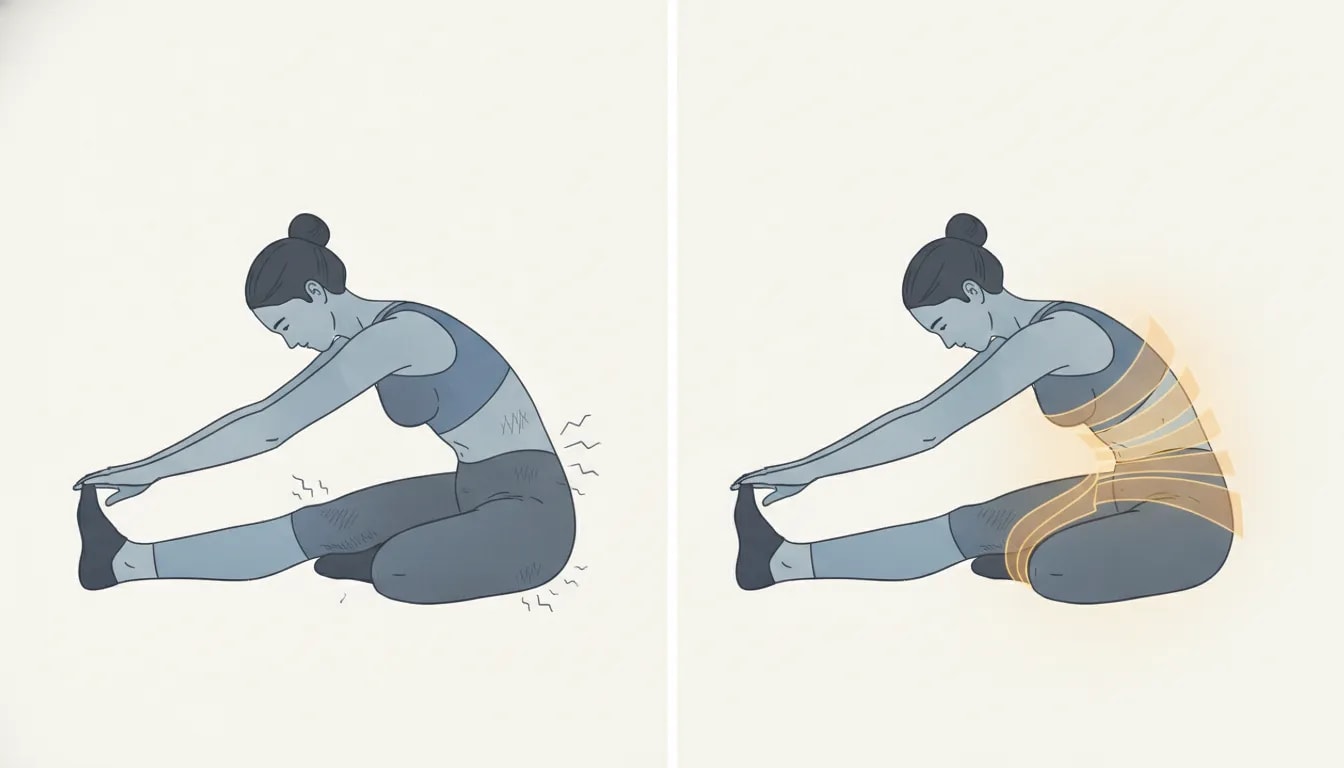
When stretching tight muscles gives temporary relief, but the same tension returns a few hours later, it can feel frustrating and confusing. Your hamstrings may pull every time you bend forward, your hip flexors may feel permanently restricted, or your upper traps may stay stiff despite daily stretching. The problem is often not that the muscle needs more length.
In many cases, tightness is the body’s way of creating stability, controlling a joint position, or protecting against a lack of strength elsewhere. If you keep stretching, the muscle doing that work without addressing why it is working so hard, the body may simply tighten it again.
Stretching tight muscles is not always wrong. But it is often incomplete. A more useful question is: what job is this muscle trying to do, and what would need to improve for it to stop doing that job all day?
Table of Contents
- Tightness Is Often a Job, Not Just a Lack of Flexibility
- The Muscle That Feels Tight May Already Be Too Long
- Find the Joint Position Behind the Tight Muscle
- A Better Approach Than Stretching Every Tight Area
- Common Mistakes When Stretching Tight Muscles
- When Stretching Can Still Have a Place
- FAQ About Stretching Tight Muscles
- The Takeaway: Treat the Reason for the Tightness
Tightness Is Often a Job, Not Just a Lack of Flexibility
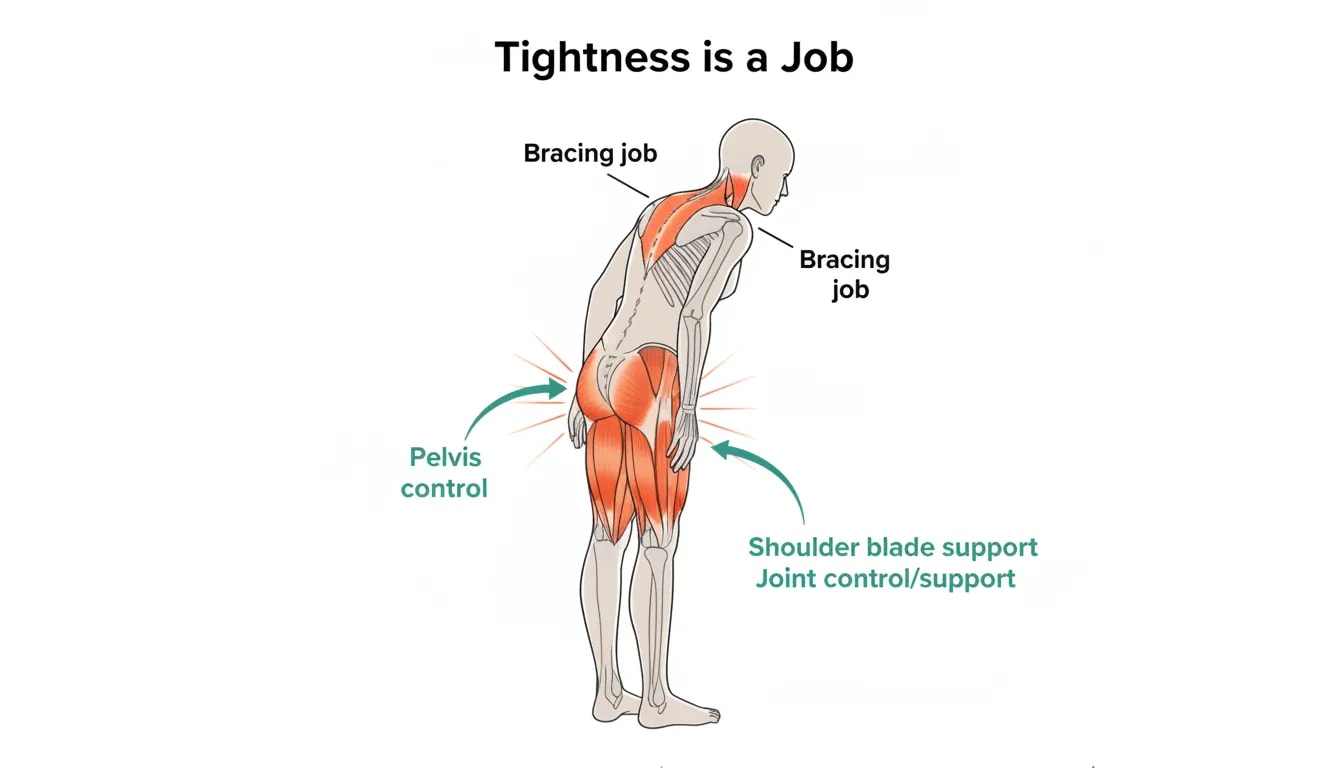
A muscle that feels tight may be actively holding a position that is not being adequately supported elsewhere. It is not necessarily “stuck,” shortened, or in need of aggressive lengthening. It may be bracing because the body does not trust the surrounding joints to remain stable without it.
For example, hamstrings can stay tense when the pelvis lacks enough control. Upper traps can stay overactive when the shoulder blade is not being held well by other muscles. In both situations, the tight muscle may be compensating for a missing job.
This explains a common pattern with stretching tight muscles: the stretch feels good briefly, but the tension returns quickly. The stretch may have reduced the sensation temporarily, but it did not change the reason the body wanted that muscle switched on.
Ask what would happen if the muscle relaxed
Before deciding to stretch, consider what would happen if the tight area completely let go. Would the pelvis lose control? Would the shoulder blade drift forward? Would the ribcage, hip, or joint position become harder to manage?
That question shifts attention away from chasing sensation and toward finding the movement problem. If a muscle is stabilizing because nothing else is doing enough, removing its tension without replacing its support is unlikely to create a lasting change.
- Tight hamstrings: consider hip and pelvic control.
- Tight upper traps: consider whether the shoulder blade has enough support.
- Tight hip flexors: consider whether the pelvis is being held in a useful position.
- Tight chest and upper traps: consider how the shoulder blade is positioned and controlled.
The goal is not to force the tight muscle to relax. The goal is to give the body a better way to organize the joints it crosses.
The Muscle That Feels Tight May Already Be Too Long
One of the biggest mistakes in stretching tight muscles is assuming that a pulling sensation always means the muscle is short. A muscle can feel tight while already being held at a long length for much of the day.
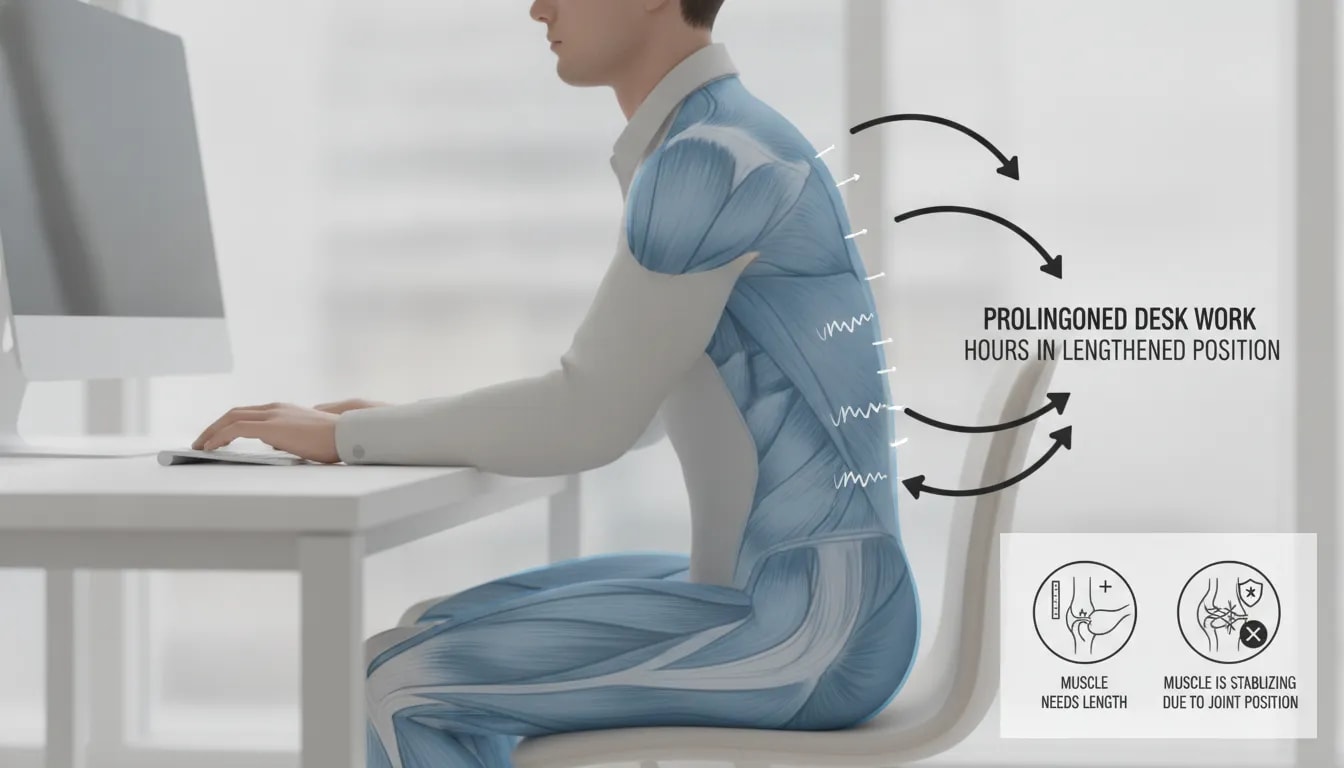
Consider an upper back that feels tense during prolonged desk work. The muscles may be held in a lengthened position for hours while trying to manage the position of the shoulders and upper body. Similarly, hamstrings can feel tight when pelvic position keeps them under continuous pull.
In these cases, the sensation may come from tension at a long length, not from a simple shortage of range. Stretching a muscle that is already under lengthened tension can add more pull without solving the underlying demand.
Look for tightness combined with weakness
A useful clue is whether the muscle feels tight but also weak in that position. Can it contract strongly when placed in its shortened range? Or does it feel difficult to create force there?
If a muscle feels restricted yet struggles to work when shortened, it may need better loading and control rather than more length. This is where short-range strengthening can be more valuable than repeated stretching.
Short-range work is not always comfortable or dramatic. It requires the muscle to produce force, where it may be poorly coordinated or underused. However, this approach directly addresses the possibility that the muscle lacks strength and control, rather than flexibility.
For more context on how breathing, tension, and movement control can interact, explore this guide to diaphragmatic breathing for chronic pain and better movement.
Find the Joint Position Behind the Tight Muscle
Muscles do not experience tension in isolation. They cross joints, pull on bones, and respond to the positions those bones occupy. When a joint is not held well, the muscles around it are placed at different lengths and may become tense as they try to manage the new position.
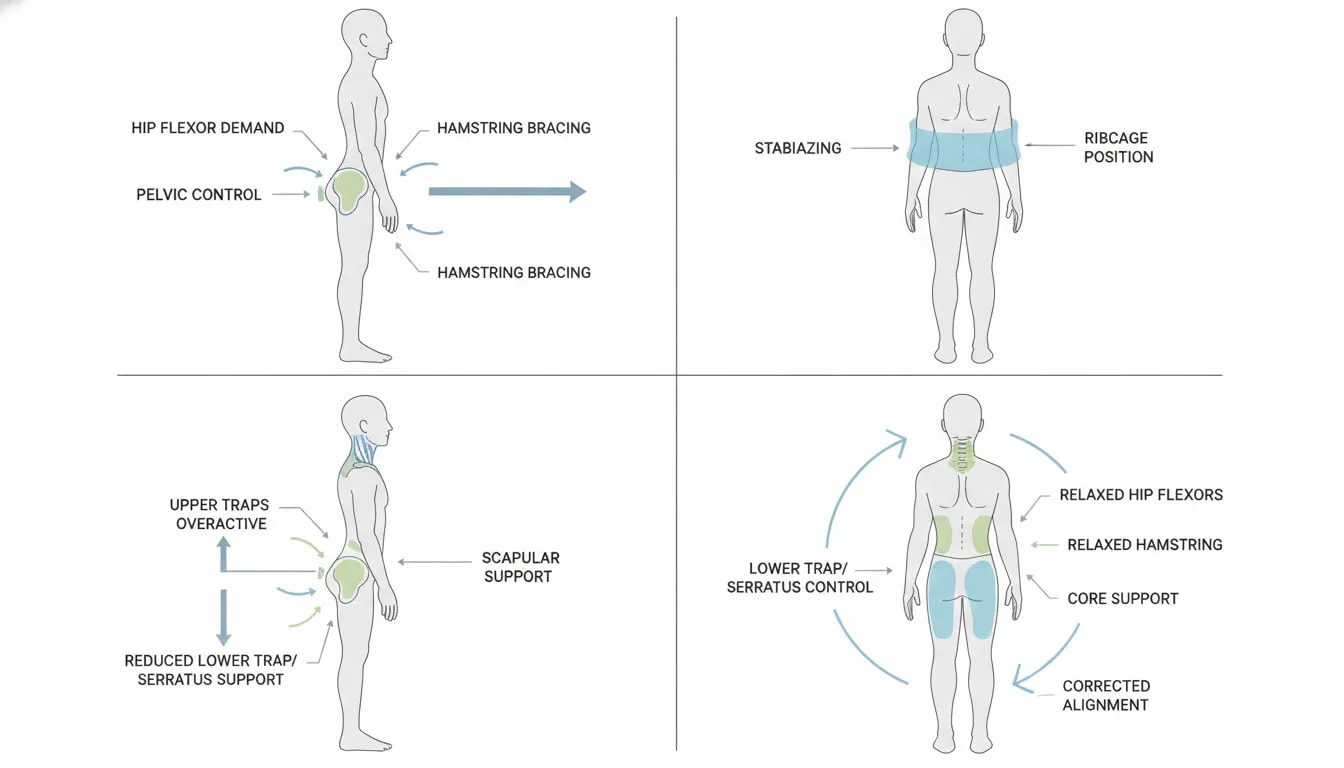
This is why the painful or tight muscle is not always the primary problem. It may simply be responding to where the skeleton has settled.
If one muscle group stops contributing enough, the bone it influences can drift. The pelvis may tip, the ribcage may drop, or the shoulder blade may slide forward. Every muscle crossing that joint must then deal with the altered position.
Examples of position-driven tightness
Tight hip flexors may be linked to how the pelvis is controlled. If pelvic position is not well managed, the front of the hip can remain under constant demand. Repeatedly stretching the hip flexors may not address why they are trying to hold that position.
Tight upper traps may be linked to a shoulder blade that lacks support. If the shoulder blade drifts forward or is poorly controlled, the upper traps may stay active to help organize the area. Improving lower trap and serratus contribution can help transfer some of that workload.
Tight hamstrings may be related to pelvic control rather than a need for more hamstring length. When the pelvis is not stable, hamstrings may brace to provide support. Training hip and pelvic control can reduce the need for that bracing response.
This is the central idea behind smarter stretching tight muscles: first identify the joint position, then identify what should be helping to hold it there.
A Better Approach Than Stretching Every Tight Area
You do not need to ban stretching. Instead, stop making stretching the automatic answer to every sensation of tightness. Use it as one possible tool after you understand whether the muscle actually needs length, support, strength, or a change in joint control.
A practical approach has four parts.
1. Identify the exact position that creates the tightness
Notice when the muscle feels most restricted. Is it tight when sitting, standing, reaching overhead, bending forward, or holding a particular posture? The context matters because it can reveal which joint position is creating demand.
A hamstring that feels tight only when the pelvis is tipped may need a different strategy from a hamstring that is limited in every movement. Likewise, upper trap tension during reaching may point toward shoulder blade control rather than a simple neck flexibility issue.
2. Check whether the area is doing too much work
Ask whether the tight muscle seems to be constantly active. Does it tense during tasks that should feel easy? Does it rapidly return to tension after being stretched? Does it take over when you try to move another part of the body?
These signs do not prove the cause, but they are useful prompts to look for compensation. A muscle that continually returns to tension may be filling a stability or control gap.
3. Train the support that should share the load
Once you identify the likely joint position, focus on improving the muscles that should help control it. For the pelvis, that may mean training hip and pelvic control. For the shoulder blade, it may mean improving lower trap and serratus contribution.
The objective is shared workload. When the appropriate muscles can hold their part of the position, the previously tight muscle may no longer need to remain on guard.
4. Reassess the tight muscle after loading
After working on control and strength, revisit the movement that previously felt restricted. Notice whether the sensation changes without additional stretching. If it does, that is useful information: the tightness may have been related more to support and positioning than to missing range.
This reassessment matters because it prevents endless stretching tight muscles based only on how they feel in the moment. The body’s response to better control is often more informative than the temporary feeling after a stretch.
Common Mistakes When Stretching Tight Muscles
The main issue is not that people stretch. The issue is using stretching as the only response, regardless of what is causing the tension.
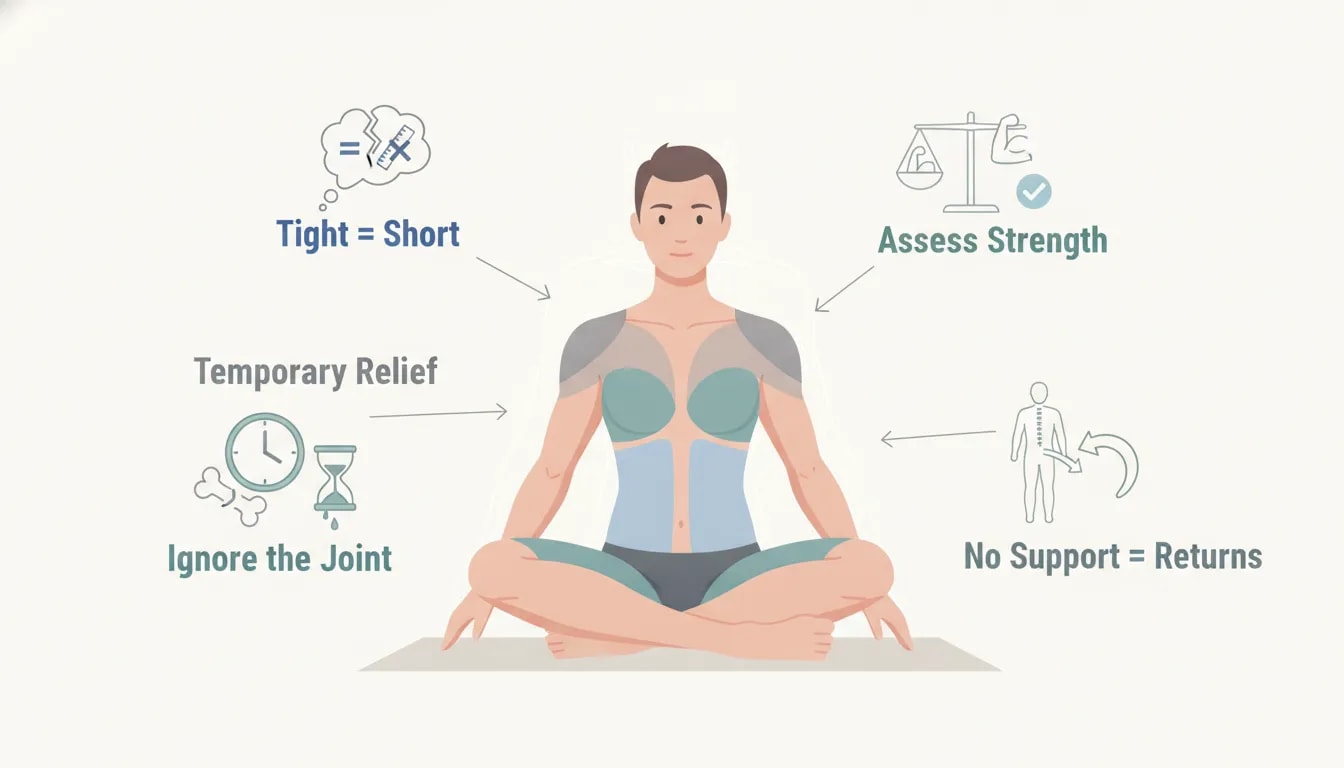
- Assuming tight means short: a muscle can feel tight while already being held long and under tension.
- Chasing temporary relief: a stretch can change sensation without changing the reason the tension returns.
- Ignoring the joint: muscles respond to the positions of the bones and joints they cross.
- Stretching before assessing strength: tightness plus weakness may call for loading rather than lengthening.
- Trying to relax the compensating muscle without building support: if nothing replaces its job, the body may recruit it again.
Another mistake is treating each tight area as unrelated. Tight hamstrings, hip flexors, upper traps, and chest muscles can each be part of a larger movement pattern. Looking at the position of the pelvis, ribcage, and shoulder blade is often more useful than treating the sorest muscle as the only problem.
If recurring tightness is part of a broader movement or pain issue, the resources in the Movement and Pain Blog can help you explore related movement concepts.
When Stretching Can Still Have a Place
Stretching tight muscles can still be useful when it improves comfort, helps you access a movement, or supports a broader training plan. The key is to avoid expecting the stretch alone to create a permanent solution when the muscle is tight because it is compensating.
Use the result as feedback. If stretching produces a brief change that disappears quickly, look beyond the muscle. If the area improves as you build strength and control around the relevant joint, keep prioritizing that direction.
A good movement plan does not choose between mobility and strength as if they are opposites. It uses the right tool for the actual problem. Sometimes that means lengthening. Often, it means improving the body’s ability to hold a better position without unnecessary tension.
FAQ About Stretching Tight Muscles
Why do my muscles feel tight again after I stretch them?
The muscle may be returning to a job the body still needs done. If it is helping stabilize the pelvis, shoulder blade, or another joint position, stretching may temporarily reduce tension without replacing the support it provides. The body can then tighten it again to restore that support.
Can a muscle feel tight even if it is already too long?
Yes. A muscle can feel tight when it is held in a lengthened position and remains under constant tension. In that case, the pulling sensation does not automatically mean the muscle needs more stretching. It may need better strength and control, particularly in its shortened range.
Should I stop stretching tight muscles completely?
Not necessarily. Stretching can be useful for comfort or short-term access to movement. However, when tightness repeatedly returns, it is worth looking for the joint position, strength deficit, or control issue that keeps the muscle working overtime.
What should I strengthen for tight hamstrings?
Start by considering hip and pelvic control. Tight hamstrings can be bracing because the pelvis lacks a stable base. Rather than assuming they need more length, assess whether improving control around the hips and pelvis changes the hamstring sensation.
What should I do for constantly tight upper traps?
Consider whether the shoulder blade is receiving enough support. Tight upper traps can remain active when the shoulder blade is not well controlled. Improving lower trap and serratus contribution may help share the work that the upper traps have been trying to handle alone.
The Takeaway: Treat the Reason for the Tightness
When stretching tight muscles does not create lasting relief, do not assume you need to stretch harder or longer. The muscle may be tense because it is stabilizing, compensating, or working at an uncomfortable length due to the position of a joint.
Start with the muscle that feels tight, but do not stop there. Identify the joint it crosses, consider what has drifted out of position, and build the strength and control that should share the load. When the muscle no longer has to do everyone else’s job, it has a better reason to let go.